
Curators
Lorelai MursaStuck Inside a Children’s Book by Cristian Bara
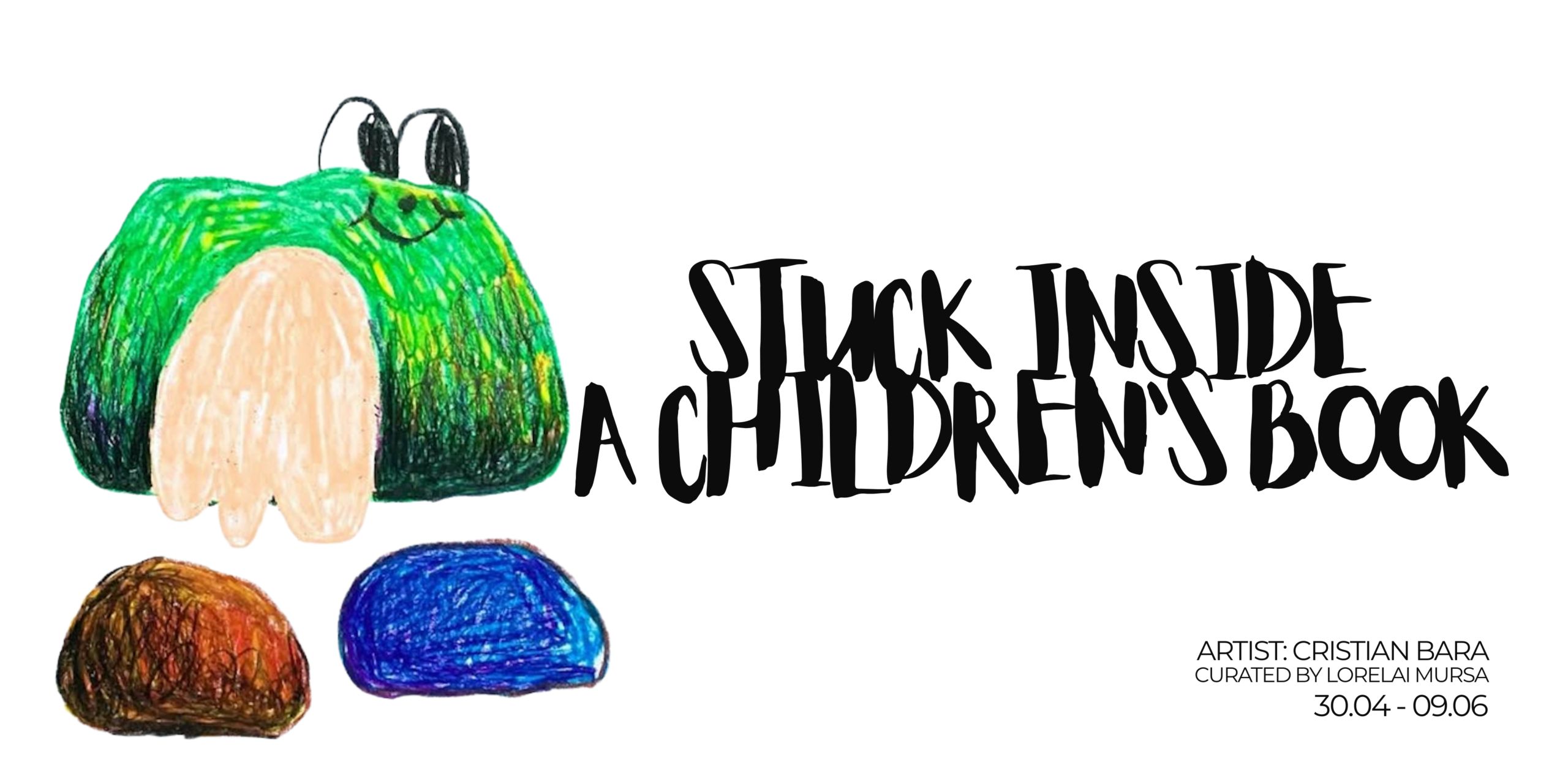
The exhibition Stuck Inside a Children’s Book unfolds as an entry point into a space where the image functions like pages that do not unfold linearly, coexisting within an open field. The absence of a clear beginning and a stable closure produces an accumulation of states, fragments, and returns, a suspended narrative in which the viewer does not move forward, but remains. Within this framework, Cristian Bara’s practice is grounded in an explicit shift of attention: “from the external world to the internal one.” The works developed since 2024 emerge through a process of introspection in which tension is absorbed and translated into a direct, fluid visual language, free of rigid constraints.
The title operates as a reading mechanism. The “children’s book” becomes a structure of perception, a space governed by free association, intensity, and immediacy. Being “stuck” within this space implies remaining in a state where experience has not yet been fixed. Childhood functions here as a mode of operation. The visual universe is “playful, joyful, and light,” populated by recurring signs: faces, structures, unstable forms acting as points of reference within an internal topography. These elements define an affective space in continuous transformation, where repetition stabilizes, temporarily, a flow that resists fixation.
A constant need for recalibration runs through the works: “a grounding in the present moment,” in which experiences lose intensity and reorganize. Cristian Bara describes this as a distancing from emotional accumulation “a step back from the heavy or unpleasant aspects” after which what remains is “a smile, a breath, a release.” This “smile” functions as a marker of internal transformation.
In continuity with his earlier practice, the notion of space and landscape persists, internalized. Landscape becomes a mental and affective construction “places suspended in time and space,” gardens, structures, or sites of retreat functioning as extensions of a sensitive memory.
These spaces recall an early experience of the world, perceived as open, unstable, and infinitely possible. The artistic style stands at the limit between the abstract and the figurative, with the artworks illustrating the concept of space and the way it is perceived and experienced. The visual language is defined by fluidity and direct application: colors flow, forms remain unfixed, composition avoids rigidity. This openness maintains the works in a state of becoming, close to the logic of an image that has not fully stabilized, “like something emerging from a dream or a reverie you are trying to remember.” In this context, the works also function as a form of controlled exposure: “each work is an opportunity to set aside, for a moment, the masks I wear and to take a break from being ‘myself,’ while at the same time probably being the most authentic ‘myself’ possible.” This dimension emerges through simplification, as a return to a register in which experience can be felt directly.